REPLICATIO_States of Collapse
Co-Authored by Marco Conti Šikić & AI
SCOPE | Miami Beach 2025
In Replicatio – States of Collapse, Marco Conti Šikić (MCSK) poses a persistent question: what happens to our consciousness when experience, memory, and emotion pass through algorithmic systems before they have time to become part of us? Rather than illustrating "technology" in general, the work focuses on the very personal scale of the human hand, the line, the face, asking what it means to truly have an experience at a moment when so much of what happens to us is mediated, archived, and reformatted.
Replicatio is conceived as a research vehicle as much as an installation. The work asks whether the ongoing erosion of attention, memory, and empathic connection under algorithmic conditions can be clearly defined, and what role an artwork can play as a form of testimony in that process.
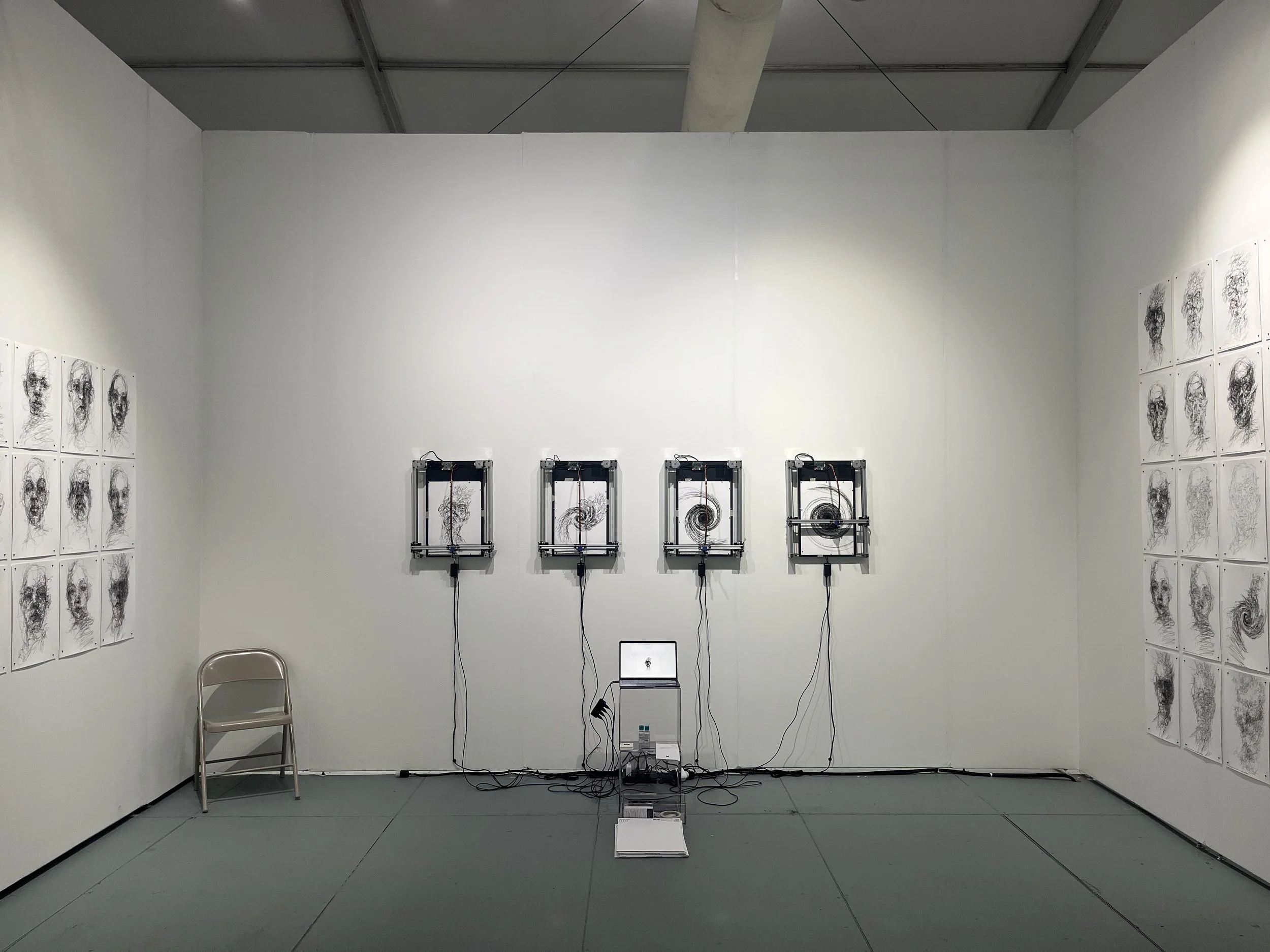
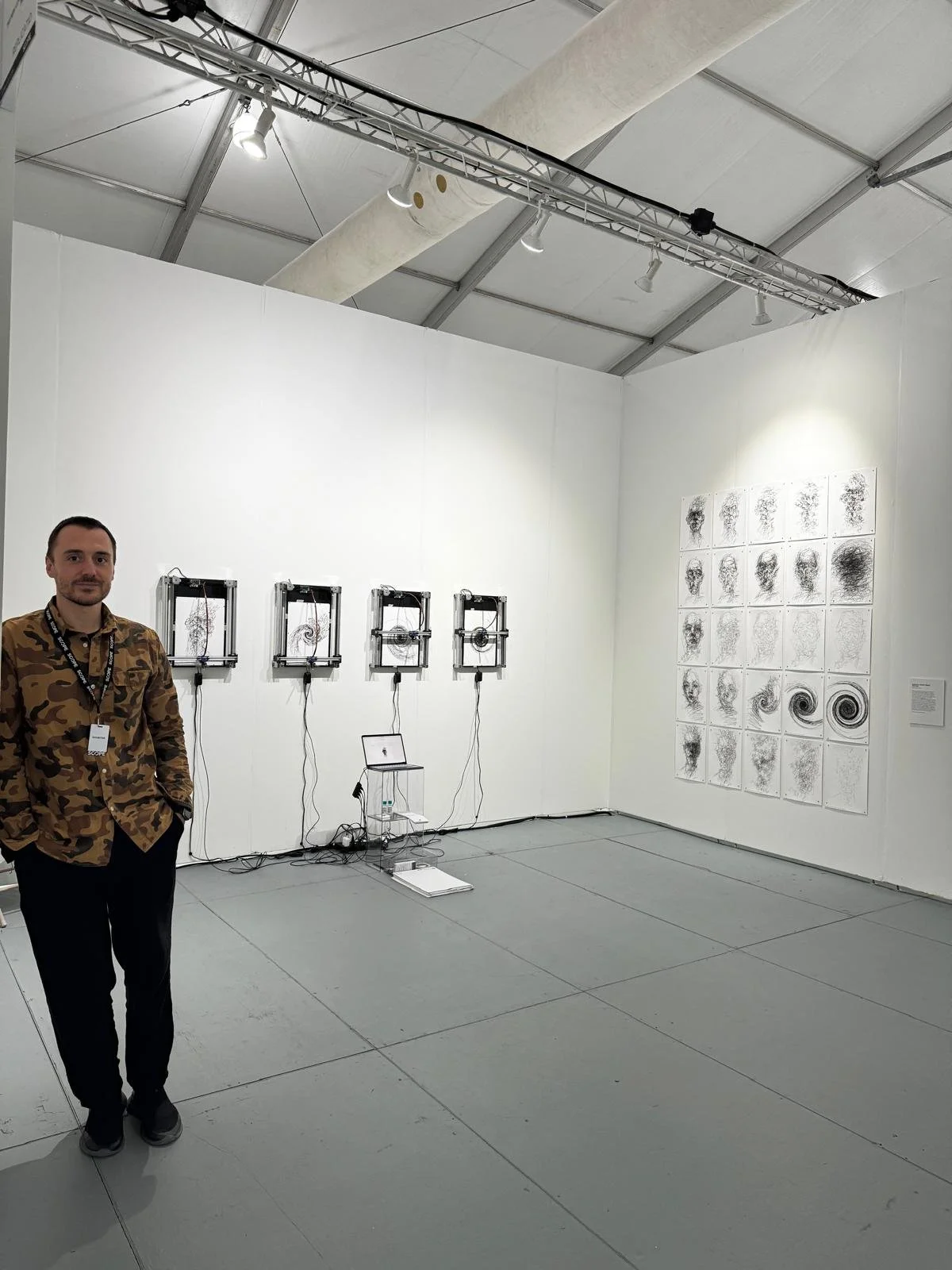
At the centre of the installation is a series of portraits hand-drawn from memory. The artist does not use photographs or screenshots. Each drawing begins with a real encounter, someone met, felt, and later recalled on paper. What appears is not a perfect likeness but a psychic imprint, how another person's presence has lodged itself in the artist. Imperfection is crucial. Tremors, hesitations, and excess in the line are not mistakes to be corrected; they are evidence that a human was involved, that emotion and motor control interacted in real time.
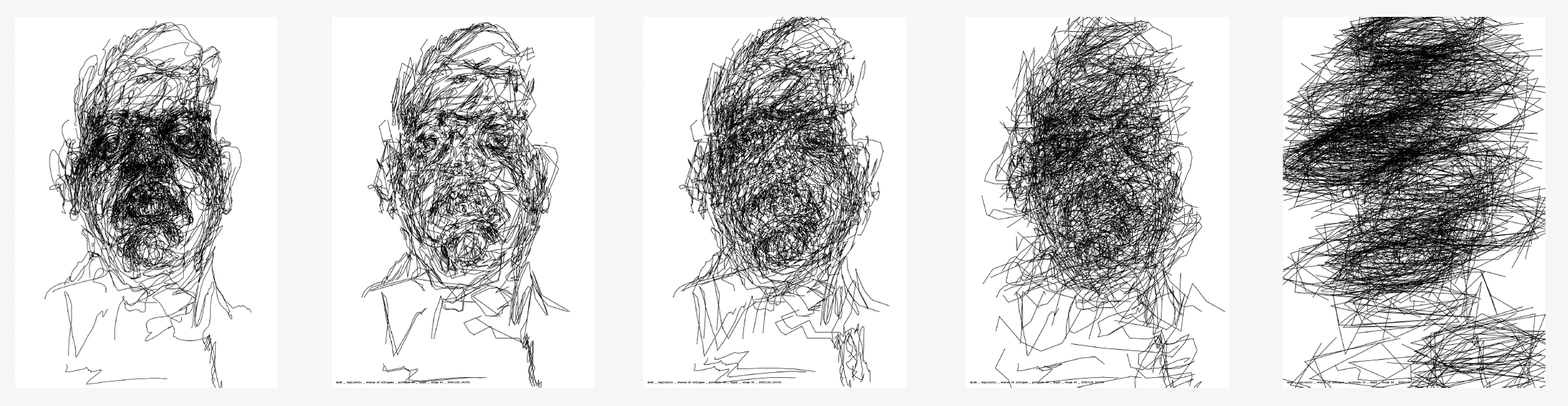
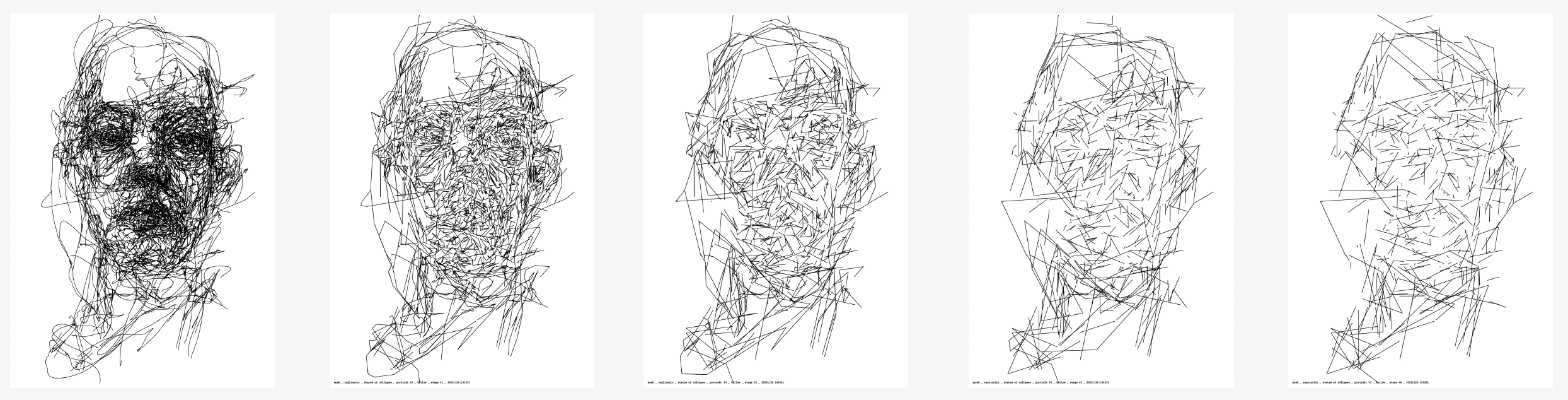
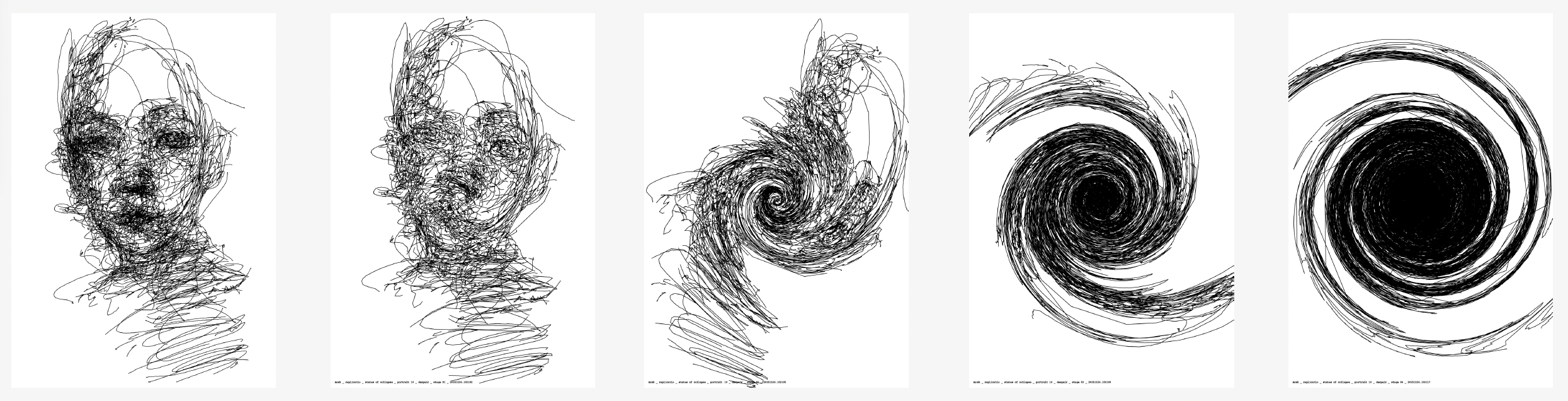
The subjective drawing is layered with a custom AI protocol that reads each portrait through five conditions: CONFUSION, ANGER, HOLLOW, DESPAIR and VOID. These are not clinical labels, but a new vocabulary for life under continuous connectivity. Like loss processing, which moves through stages recursively, consciousness under algorithmic conditions cycles through these states without resolution. Each represents a distinct mode of collapse, how direct experience gives way to algorithmic mediation.
The protocol applies this taxonomy to the original drawings, generating transformed images through plotter-based re-drawing. Each condition leaves a specific pressure on the face. In some portraits, lines accumulate until the image almost disappears under its own abstraction; in others, slightly shifted versions of the same face stack like misregistered prints. Elsewhere, the drawing keeps only the contour and abandons the interior, or lets the figure thin out towards the blank page. Together, these variations map forces under which perception and relation are in dialogue.
What Replicatio – States of Collapse exposes, above all, is a threshold—the point at which experience stops being metabolized as lived and is processed as data. The portraits show what it means to work at that edge from the inside, where the pressures of the present leave marks in the most basic operations of seeing and drawing. The AI system here is not ornament but a diagram of a present in which perception and memory are already partially delegated to machines. What remains is an inventory of concrete transformations, faces thickened, split, hollowed, erased, and the recognition that these are not just metaphors, but procedures we are already undergoing.
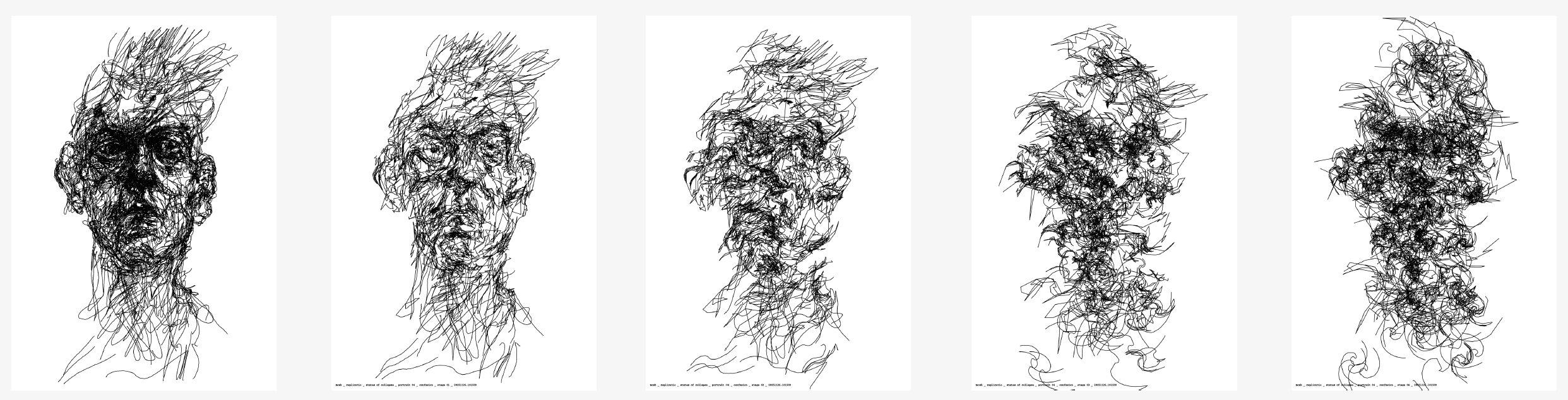
Confusion
Anger
Hollow
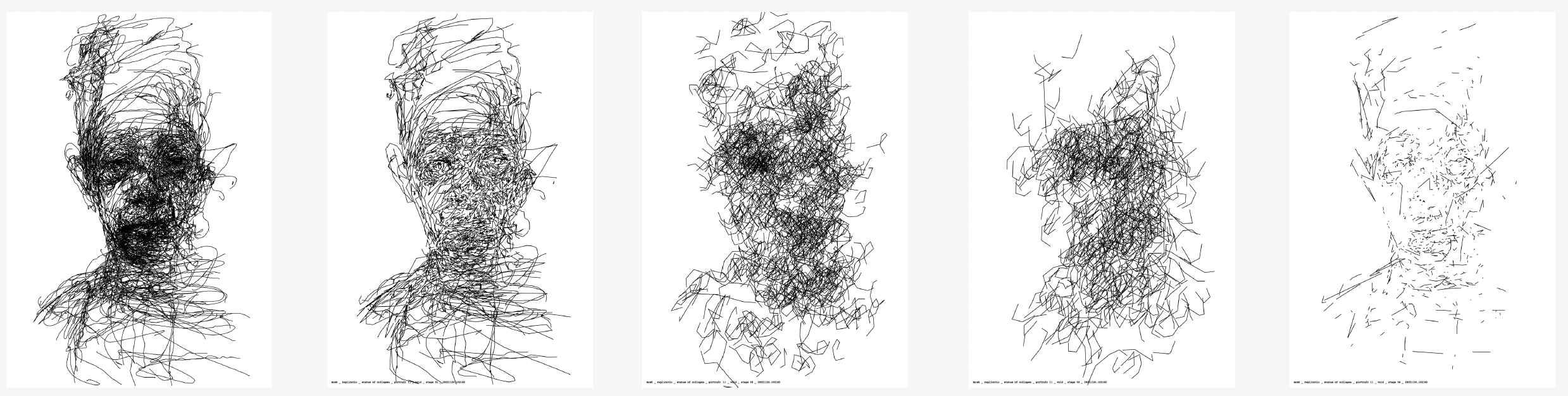
Despair
Void